Spanishtown, or Half Moon Bay as it is now called, is the oldest settlement in San Mateo County, dating back to the 1840s. The land was originally inhabited by Costanoan Indians for hundreds of years who lived along Pilarcitos Creek. Cabrillo Highway (Highway 1) and Highway 92 follow the original Costanoan trails along the coast and over the mountains. In the 1840s, land grants were deeded to early Spanish settlers, and Mexican and Chilean laborers soon followed. Soon after, the village was dubbed "Spanishtown."
In 1874, Spanishtown officially became known as Half Moon Bay. In the late 1800s, the area's character was again altered by the arrival of Canadians, Chinese, English, Germans, Irish, Italians, Scots, Portuguese and Pacific Islanders. With the diverse representation of cultures, the Coastside became a prime example of the American melting pot.
The 1906 earthquake destroyed the last of the Spanish adobes, although wooden structures still remain. In 1908, the Ocean Shore Railway was constructed along the shoreline from San Francisco to Tunitas Glen. Due to financial problems and the increasing popularity of the horseless carriage, the railroad ceased operation in 1920. Half Moon Bay came alive again during The Prohibition Era, from 1920 to 1933, because the hidden ocean coves and thick fog provided the ideal setting for rumrunners from Canada.
The city of Half Moon Bay was incorporated in 1959 and today is the largest town in San Mateo County. A town of approximately 12,500 people, Half Moon Bay remains very similar to its early beginnings in the mid-1800s as an agricultural town. Fields of flowers, artichokes, brussel sprouts, Christmas trees, pumpkins and other crops blanket the breathtaking landscape.
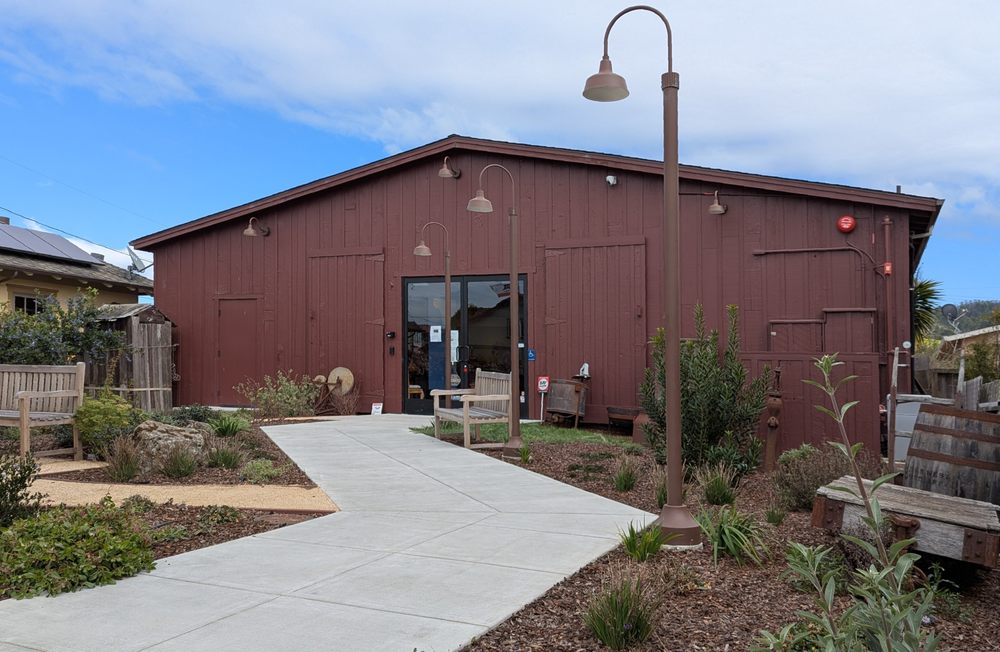
Half Moon Bay has been diligent in preserving its history, with traces of its past visible in the many historic buildings in downtown Half Moon Bay. The historic business district still shows signs of what downtown was like in earlier days. Present day "explorers" of Half Moon Bay will still see original farms dating back to the 1800s, as well as miles of deserted white sandy beaches, redwood forests, beautiful state parks, fields of wild flowers, and hiking and biking trails along ocean bluffs and mountain ridges as far as the eye can see.
The Spanishtown Historical Society, located in the former Half Moon Bay Jail at 505 Johnston Street, has a self-guided walking tour booklet available for purchase that features more than 50 historical homes, churches, commercial buildings, bridges and cemeteries, dating back to the mid-1800s.
A few specific points of interest include:
- The James Johnston House (1855) - This unusual saltbox-style home, known as The White House of Half Moon Bay, was built by wealthy Half Moon Bay pioneer James Johnston. The building is now listed on the National Register of Historical Places. 110 Higgins-Purisma Road
- Graveyard Hill Cemetery (1857) - Trace the history of the area's courageous pioneers at two cemeteries, Pilarcitos Catholic Cemetery (in operation from 1820-1923) and International Order of Oddfellows Cemetery. Located on the north side of Highway 92, just east of Main Street.
- Estanislao Zaballa House (1863) - This home was built by Spaniard Estanislao Zaballa who is credited for plotting Spanishtown in 1863, and was the wealthy owner of a large land grant and the San Benito General Merchandise Store & Saloon. 326 Main Street, Downtown Half Moon Bay
- Angelo Boitano's General Merchandise Store and Saloon (1873) - This is the oldest place of continuous business in town. James Whitehead was the first owner to occupy this space where he operated a combined billiard saloon, barbershop and post office. 429-431 Main Street, Downtown Half Moon Bay
- Half Moon Bay Jail (1911) - Now the location of the Spanishtown Historical Society Museum and Mary Vallejo History Center, this was the official town jail for many years. Two cells still remain at the rear of the solid concrete building complete with steel bars on the windows. 505 Johnston Street, Downtown Half Moon Bay
- Half Moon Bay Bakery (1926) - Taste a slice of history at this Italian bakery. Built by Italian immigrant Nat Castiglione, this bakery become famous for its delicious Italian bread baked in brick ovens, which are still in use today. 514 Main Street, Downtown Half Moon Bay
###
Media Contact:
Kelly Chamberlin
Chamberlin Public Relations
415.336.4332
kelly@chamberlinpr.com