
On the corner of Main Street and Kelly Avenue, a towering pumpkin shares the wall with farmworkers, fishing boats, and the white outline of the James Johnston House. On the opposite side of the street, sea lions, kelp, and an octopus spiral near a map of the city. Round the corner, and a massive wave scales the side of a building.
This one downtown intersection captures much of what makes Half Moon Bay special: the ocean, farming, wildlife, history, and the people whose labor and traditions give the town its shape. The route below spans just four blocks but reveals a wealth of public art. We’ve listed artwork from north to south, but don’t think of it as a to-do list. Spend some time with each piece until its finer details emerge.
The Francis Building mural (2003)
Francis Building, 421 Main Street, south wall
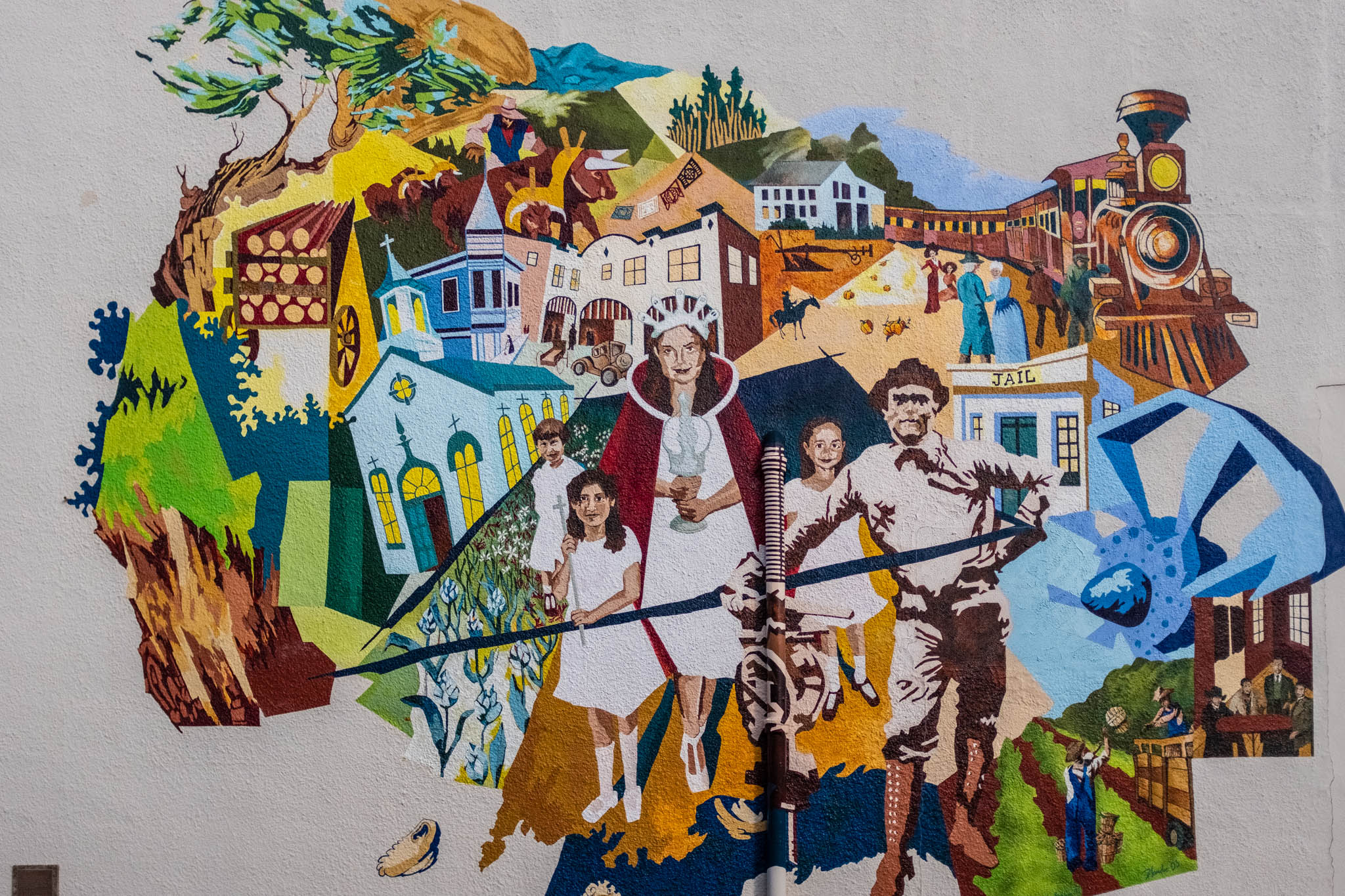
Adriana Gallego and Claudio Dicochea created the Francis Building mural in 2003, assembling scenes from Half Moon Bay’s cultural history into one sweeping composition. Historic buildings, community traditions, working life, and figures from the area’s past share the wall.
That layering makes a fitting opening. Rather than shrinking the town to one landmark or one era, the mural asks the eye to travel between scenes and to notice how many lives and traditions feed a shared sense of place.
The Mavericks mural (2009)
Cunha’s Country Store, 448 Main Street, north wall
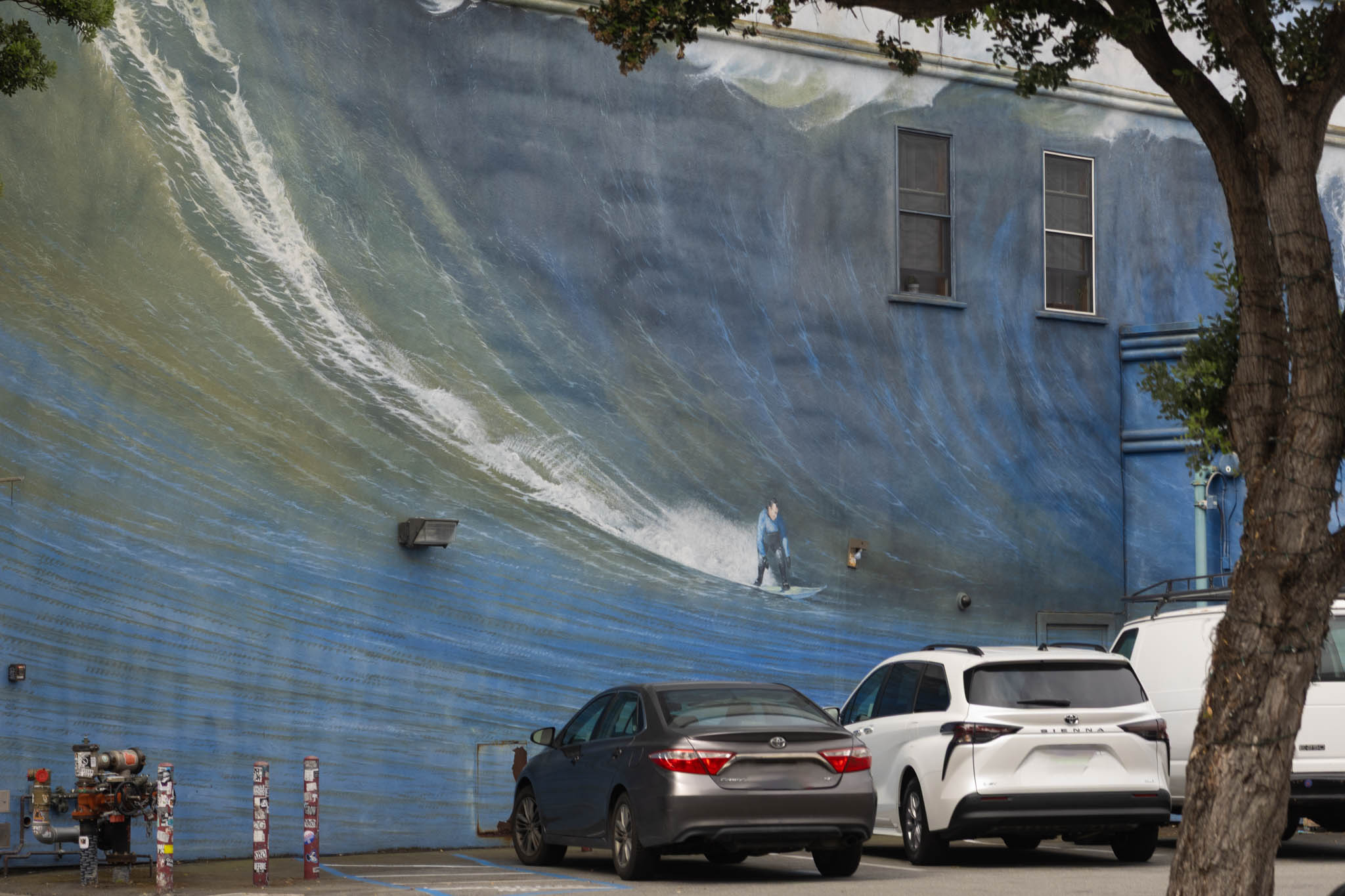
Fabio Sanzogni’s multi-story mural brings Mavericks to town. A cresting wave rises higher than the building, dwarking an image of Jeff Clark, the Half Moon Bay surfer most closely tied to the famous surf break.
Mavericks breaks offshore near Pillar Point, out of sight from Main Street, but here the wave fills the whole wall. Out on the water, the real waves can reach twice the height of this building and beyond.
The portrait keeps the piece from drifting into generic ocean scenery. This is a local wave tied to a particular surfer and to decades of big-wave history, set on one of downtown’s best-known commercial buildings.
The Pumpkin Festival mural (2022)
Cunha’s Country Store, 448 Main Street, south wall facing Kelly Avenue
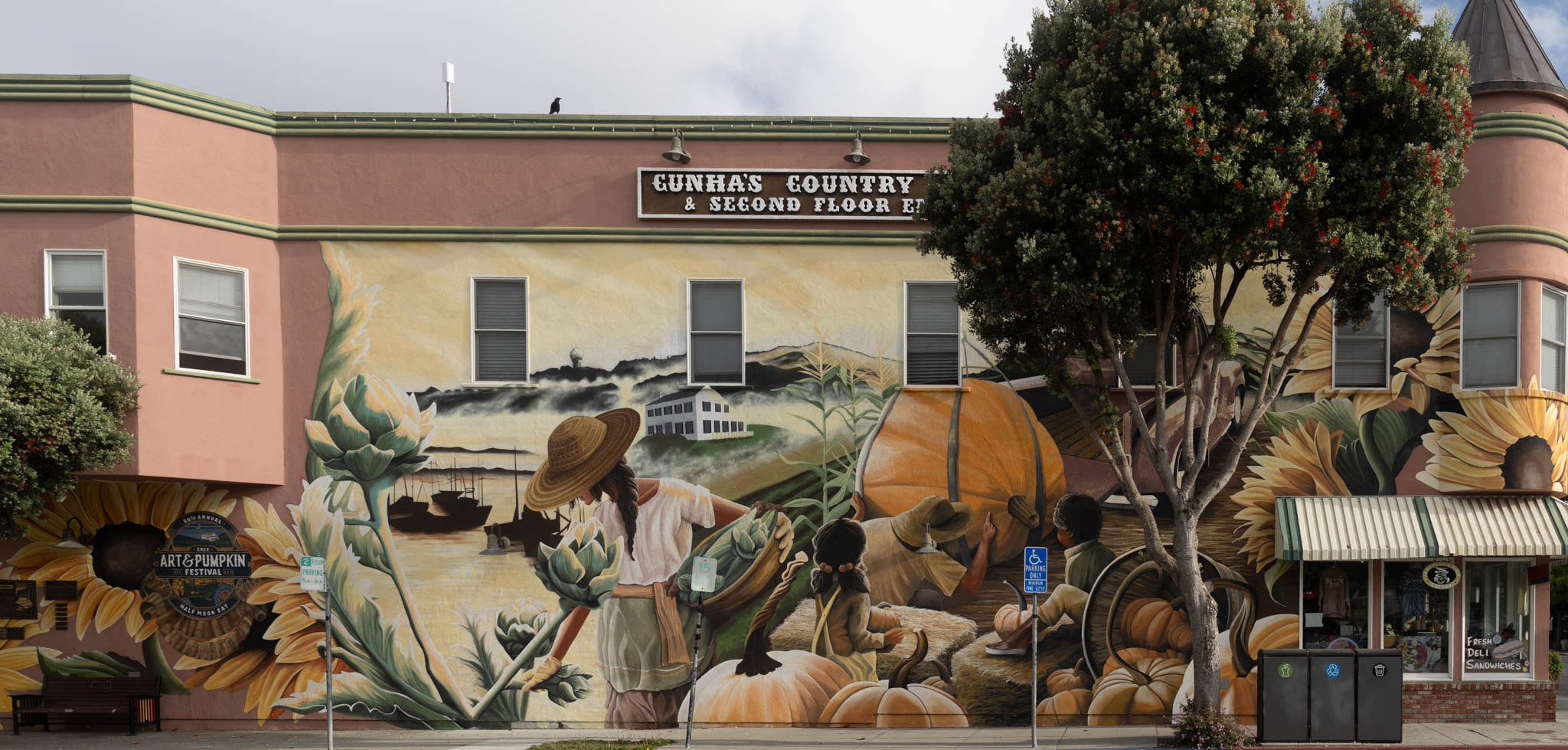
Circle around the same building and the subject shifts from surf to soil. Local artist Julie Engelmann was commissioned to paint this mural to mark the 50th anniversary of the Half Moon Bay Art & Pumpkin Festival.
The enormous pumpkins catch the eye first, but the mural weaves together many aspects of local life. Farmworkers stand among sunflowers and artichokes. Fishing boats carry the harbor into the composition, while the Johnston House rises in white against the surrounding color. Together the images tie the annual festival to the work, landmarks, and landscapes that gave it a home.
That is part of the pleasure of this corner: two large murals occupy opposite sides of the same building without fighting over the same story. One faces the offshore break. The other looks inland to fields, harvest, and a fall tradition that takes over Main Street.
City in Nature: Half Moon Bay (2022)
California Welcome Center, 508 Main Street, north wall
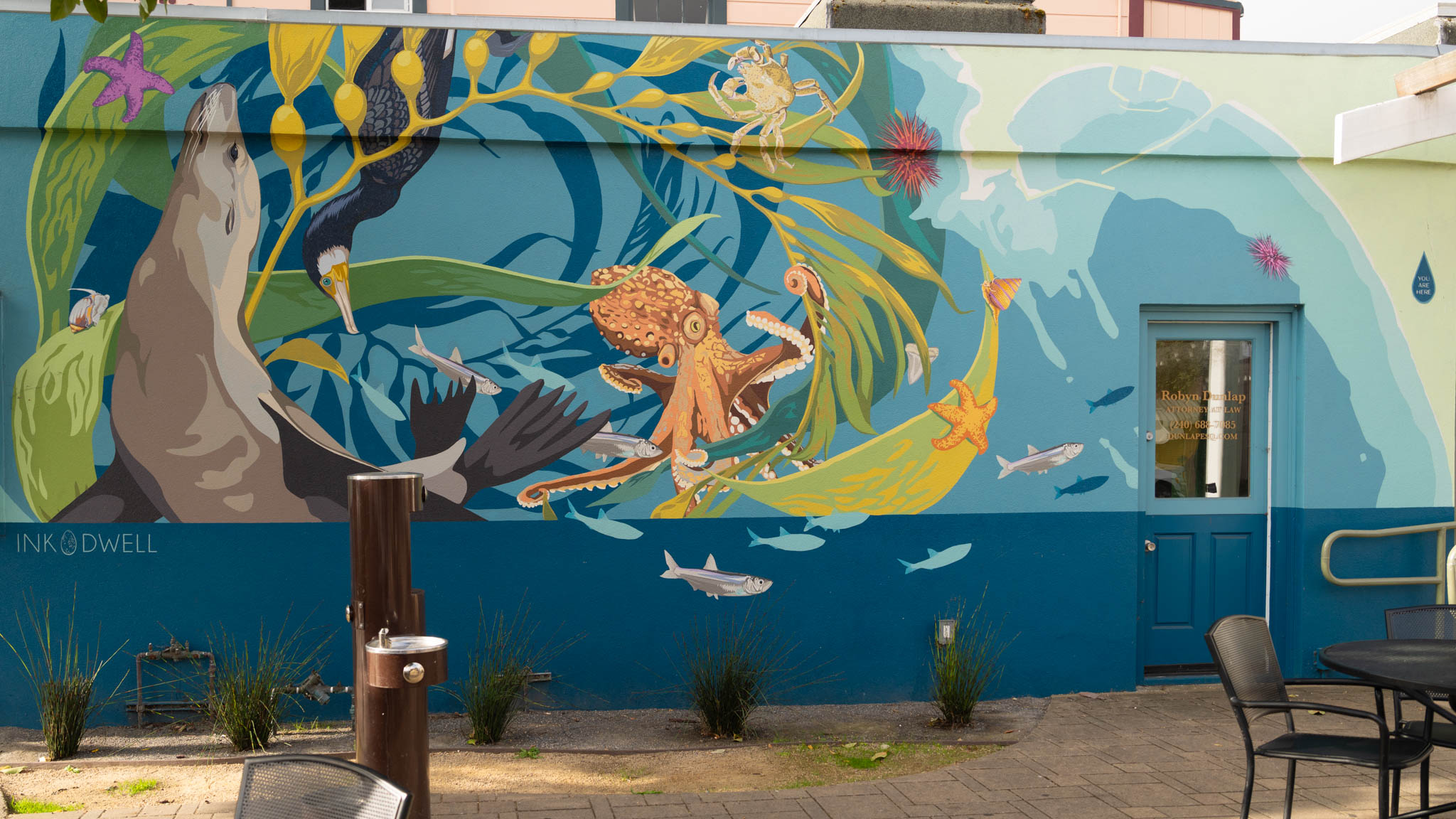
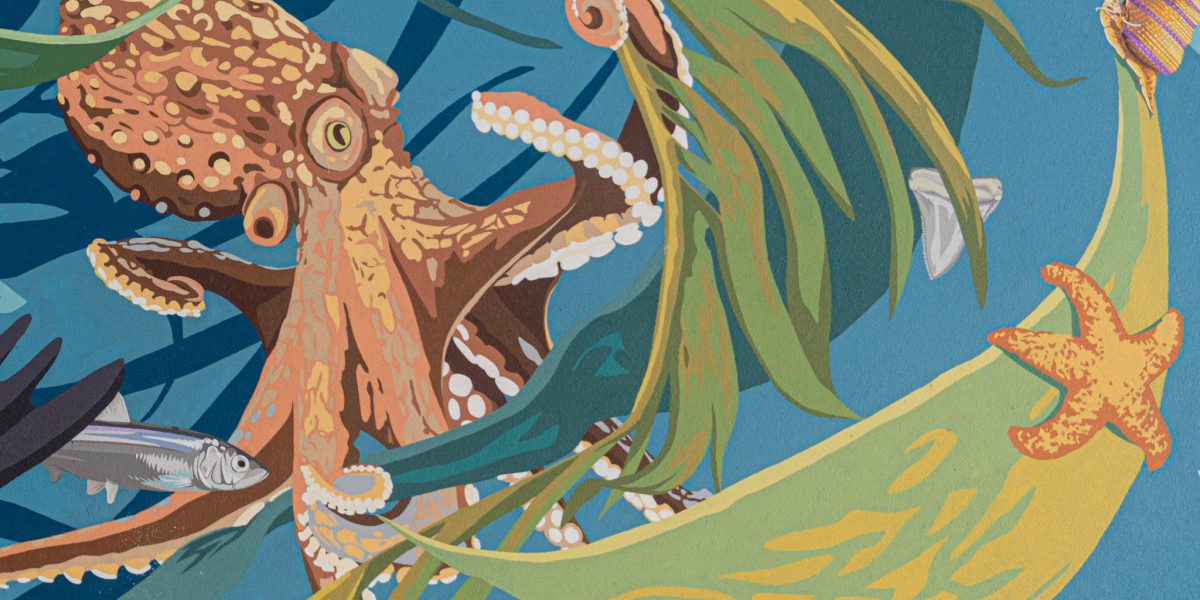
Jane Kim of Ink Dwell painted City in Nature: Half Moon Bay in 2022 as a gift from Sea Crest School, made in celebration of the school’s 25th anniversary. The composition sweeps marine life toward a map of Half Moon Bay, where a drop of water marks where you are standing.
That small marker changes how the mural works. You are not looking at a diagram of coastal nature from the outside. You are positioned inside it.
Kim’s cast of species includes a sea lion, Pacific giant octopus, great cormorant, Pacific herring, giant kelp, sea stars, urchins, a kelp crab, and several small marine snails, with a great white shark tooth tucked among them. The range invites a different kind of looking, from the instantly recognizable animals down to the tiny creatures easy to walk past.
The sweep of the composition rewards a wide photo, but the individual species deserve close-ups too.
The ALAS mural (2026)
Ayudando Latinos A Soñar, 507 Purissima Street
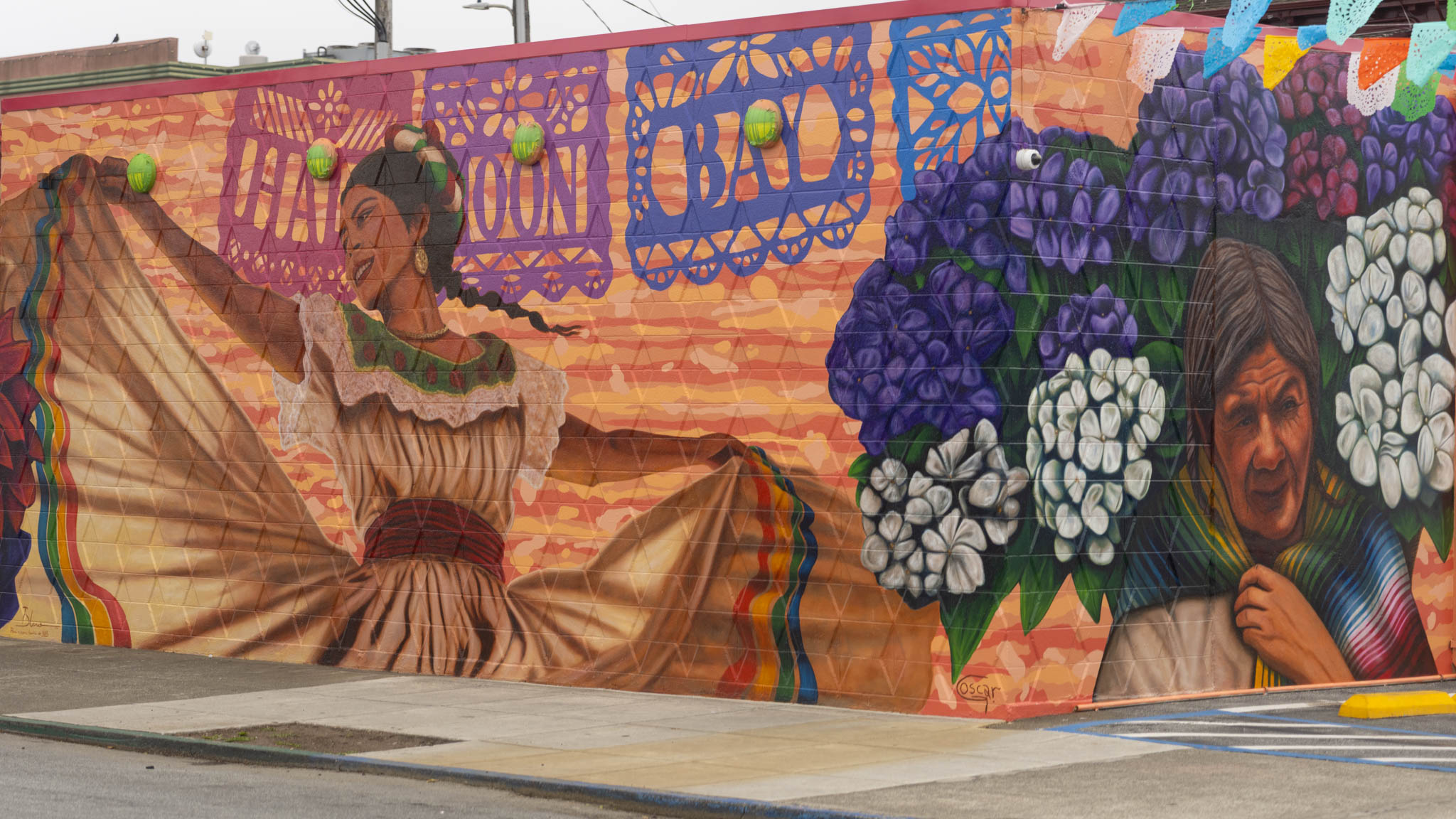
Just a block off of Main Street you’ll find the home of Ayudando Latinos A Soñar, known as ALAS. Rafael Blanco completed this mural in 2026; it wraps around the building and honors the immigrant and farmworker community the organization serves.
Three figures anchor the work: a dancer in traditional Guelaguetza dress, a farmworker carrying Brussels sprouts, and an elder framed by hydrangeas. Above them, “Half Moon Bay” stretches across the wall in lettering inspired by papel picado.
The imagery puts celebration and labor in the same frame. Dance, flowers, and cut-paper forms appear alongside a harvested crop, linking cultural inheritance with the agricultural work of local families.
The City Hall mural (2005)
Half Moon Bay City Hall, 501 Main Street, south wall
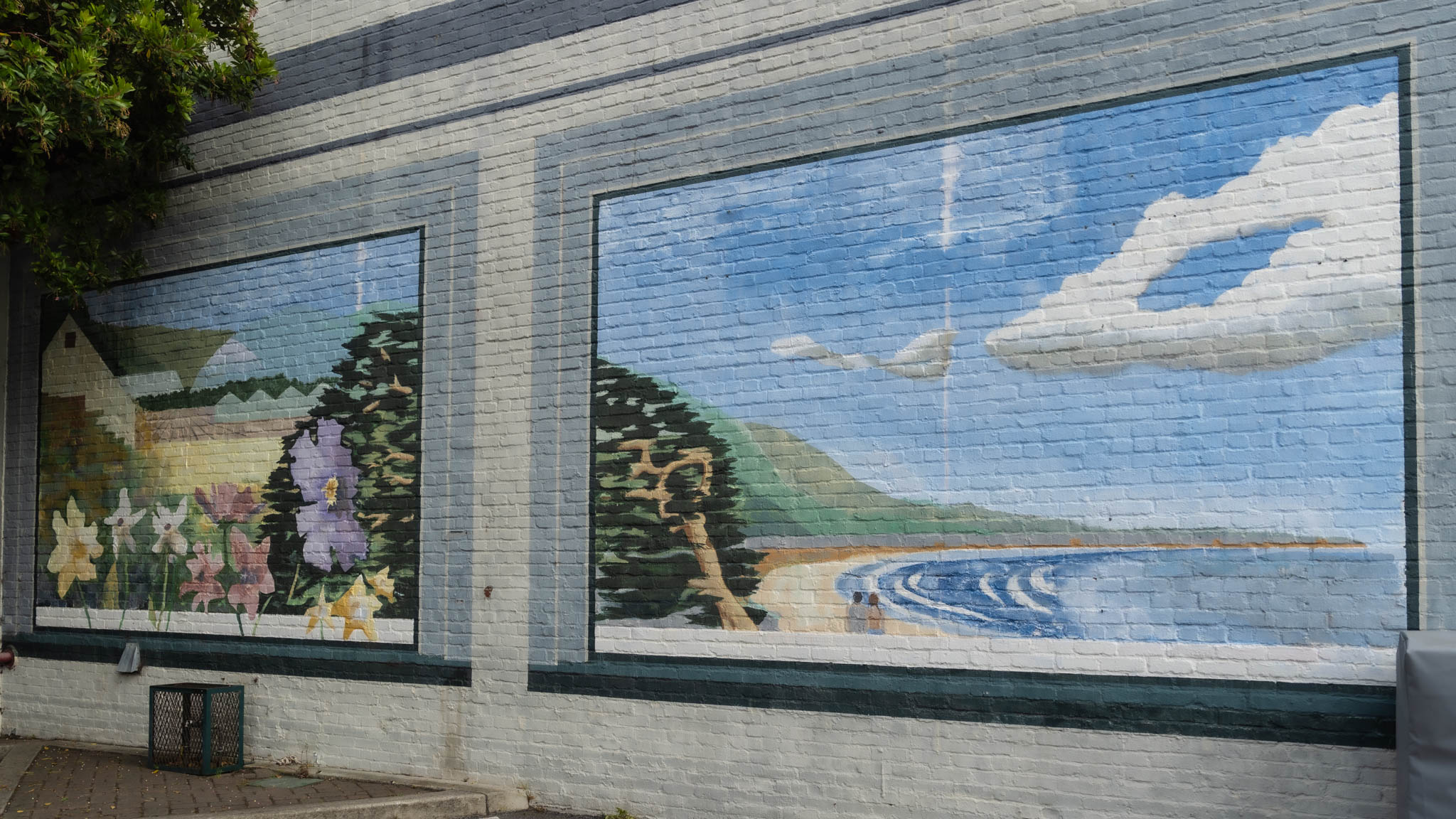
Montara architect and artist Doug Snow painted the City Hall mural in 2005, pairing two scenes. In one, two people look out across an open beach. In the other, wildflowers crowd the foreground beneath rolling hills.
The Rotary Club of Half Moon Bay commissioned the work for the centennial of Rotary International. Working in exterior latex across the large wall, Snow turned a civic building into a meeting place for the two landscapes that define daily life around town.
There is no need to choose between them. Ocean and farmland have shared the frame all along this walk, and the City Hall mural gives each a broad, quiet panel of its own.
The Spirit of Life (2022)
Beside Half Moon Bay City Hall, 501 Main Street
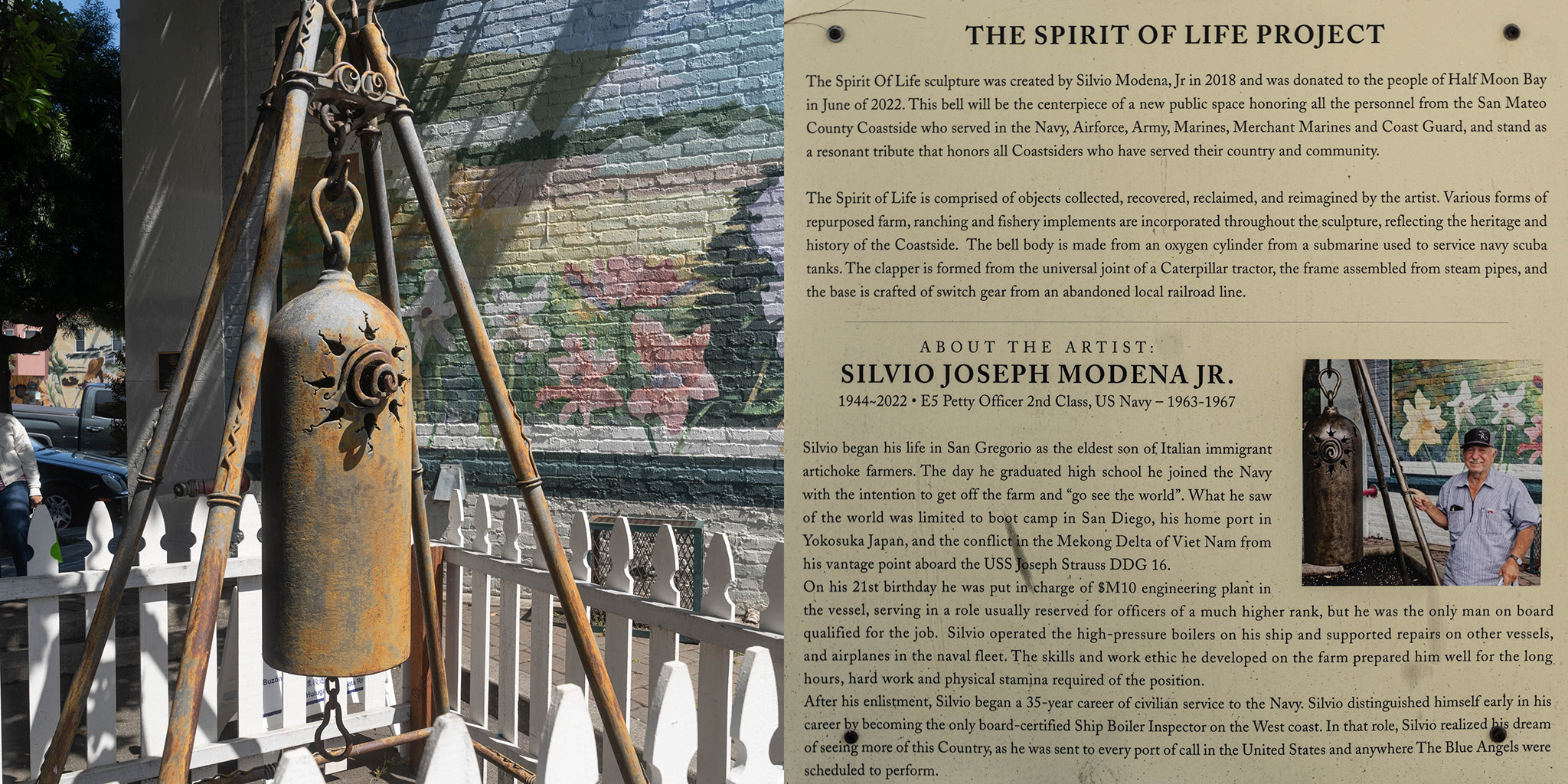
Beside the murals, The Spirit of Life invites a moment of contemplation. Silvio Joseph Modena Jr. built the bell-shaped sculpture in 2018, assembling it from recovered and reimagined objects, and it was donated to Half Moon Bay in June 2022.
The bell body began life as an oxygen cylinder from a submarine that serviced Navy scuba tanks. Its clapper came from a Caterpillar tractor’s universal joint, its frame from steam pipes, and its base from switchgear salvaged from an abandoned local railroad line. Repurposed implements from farms, ranches, and fisheries appear throughout.
Those working parts tie military service to the area’s agricultural, maritime, and railroad history. The sculpture honors people from coastal San Mateo County who served in the Navy, Air Force, Army, Marines, Merchant Marine, or Coast Guard, along with others who served their country and community.
The Goldworks mosaic
Goldworks, 542 Main Street, north wall
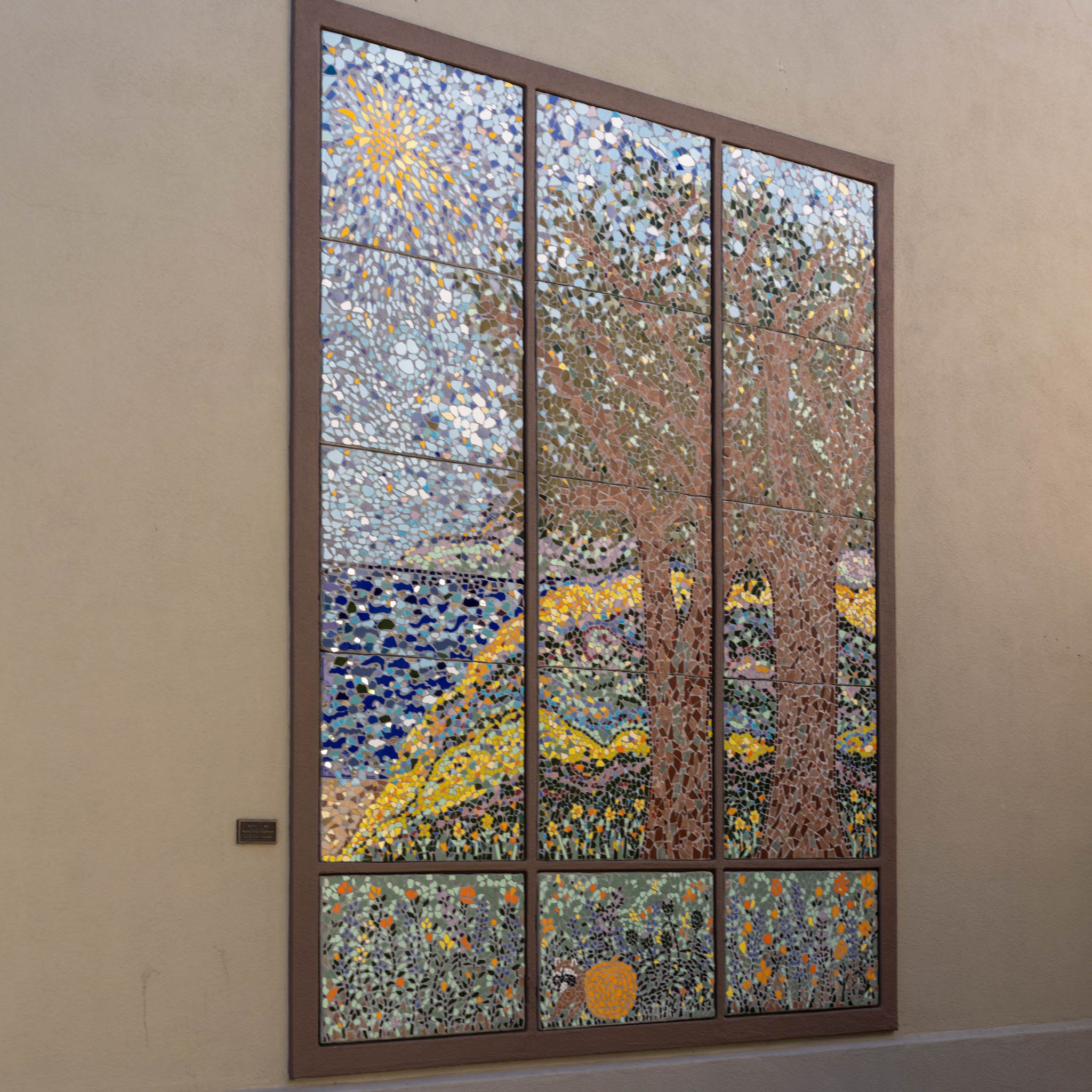
At the Goldworks building, the medium changes to tile, where artist Sue Prichard created a mosaic climbing two stories. Brown tree trunks rise toward a bright sky. The ocean glitters beyond them, and a pumpkin grows near the base.
Then comes the detail that may make you stop and re-scan the wall: a raccoon slips out from behind the pumpkin. Light plays off the individual pieces, edges stay visible, and familiar parts of the Half Moon Bay landscape get assembled from hundreds of small decisions. From a distance the work reads as a unified scene. Up close, its construction becomes part of the view.
The IDES mural (2025)
IDES Hall, 735 Main Street, west wall
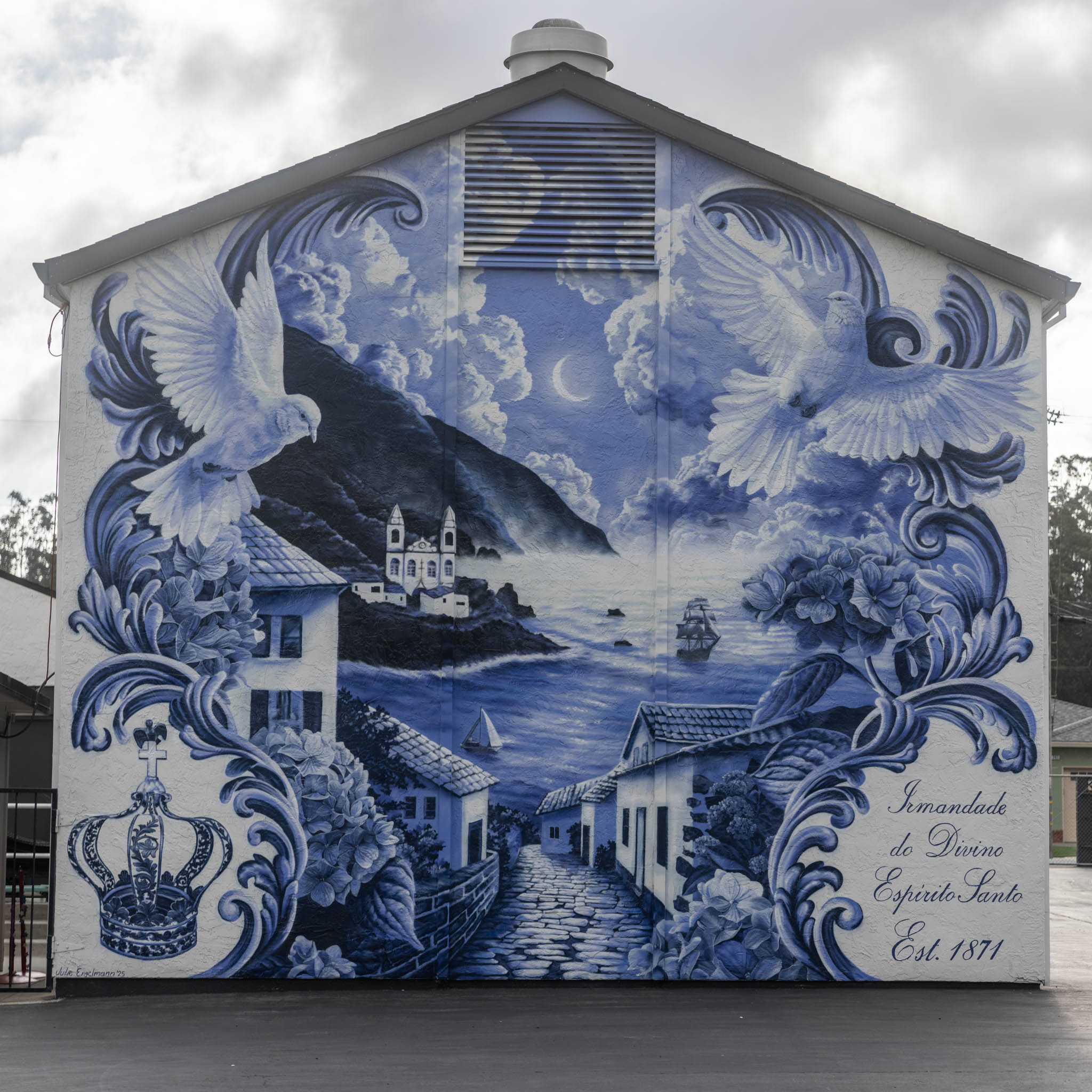
The final stop brings us back to Julie Engelmann, this time in a very different visual language. She completed her IDES Hall mural in 2025, drawing on the blue-and-white look of Portuguese azulejo tilework to honor Azorean heritage and the local traditions of the Sociedade da Irmandade do Divino Espírito Santo, known as IDES.
The palette is restrained, but the storytelling is dense. History and community customs unfold across the building in a style associated with decorated tile panels in Portugal and the Azores. The result suits an organization founded in Half Moon Bay in 1871 and still tied to local traditions like the annual Holy Ghost Festival.
At the end of your walk, one thing becomes clear, Downtown Half Moon Bay’s public art does not offer one official portrait of the town. It offers many: painted, tiled, assembled, old and new, and all on public display as daily life goes on around them. And your art walk doesn’t need to end here: continue into Half Moon Bay’s many art galleries and see what else catches your eye.